
- Home
Edition
Africa Australia Brasil Canada Canada (français) España Europe France Global Indonesia New Zealand United Kingdom United States Skip to content Edition:
Global
Edition:
Global
- Africa
- Australia
- Brasil
- Canada
- Canada (français)
- España
- Europe
- France
- Indonesia
- New Zealand
- United Kingdom
- United States
Academic rigour, journalistic flair
 A child’s toy tricycle lies amid the rubble of destroyed homes in Rafah, southern Gaza Strip, in January 2025.
(AP Photo/Abdel Kareem Hana)
Why Canada must step up to protect children in a period of global turmoil
Published: February 3, 2026 3.16pm GMT
Catherine Baillie Abidi, Mount Saint Vincent University, Izabela Steflja, Kirsten J. Fisher, University of Saskatchewan, Myriam Denov, McGill University
A child’s toy tricycle lies amid the rubble of destroyed homes in Rafah, southern Gaza Strip, in January 2025.
(AP Photo/Abdel Kareem Hana)
Why Canada must step up to protect children in a period of global turmoil
Published: February 3, 2026 3.16pm GMT
Catherine Baillie Abidi, Mount Saint Vincent University, Izabela Steflja, Kirsten J. Fisher, University of Saskatchewan, Myriam Denov, McGill University
Authors
-
 Catherine Baillie Abidi
Associate Professor, Child & Youth Study, Mount Saint Vincent University
-
Izabela Steflja
Associate Professor, Political Science, Wilfrid Laurier University
-
Kirsten J. Fisher
Associate Professor, Department of Political Studies, University of Saskatchewan
-
Myriam Denov
Professor and Canada Research Chair in Children, Families and Armed Conflict, McGill University
Disclosure statement
Catherine Baillie Abidi receives funding from Social Science and Humanities Research Council of Canada.
Izabela Steflja receives funding from the Social Sciences and Humanities Research Council of Canada.
Kirsten J. Fisher receives funding from the Social Sciences and Humanities Research Council of Canada.
Myriam Denov receives funding from the Social Science and Humanities Research Council of Canada, and the Canada Research Chair Program.
Partners

University of Saskatchewan provides funding as a founding partner of The Conversation CA.
McGill University and Mount Saint Vincent University provide funding as members of The Conversation CA.
McGill University, Mount Saint Vincent University, and University of Saskatchewan provide funding as members of The Conversation CA-FR.
View all partners
DOI
https://doi.org/10.64628/AAM.x35c9angp
https://theconversation.com/why-canada-must-step-up-to-protect-children-in-a-period-of-global-turmoil-274398 https://theconversation.com/why-canada-must-step-up-to-protect-children-in-a-period-of-global-turmoil-274398 Link copied Share articleShare article
Copy link Email Bluesky Facebook WhatsApp Messenger LinkedIn X (Twitter)Print article
Over half a billion children are now living in conflict zones, according to a 2025 Save the Children report, and the world is turning its back on them.
At a time of unprecedented global insecurity, funding and resources to care for, protect and engage with children affected by armed violence continue to decline.
The Donald Trump administration’s recent announcement of unprecedented American cuts to funding for international organizations — including reductions to the United Nations Offices of the Special Representatives of the Secretary-General for Children in Armed Conflict and on Violence Against Children — further undermines an already fragile system.
Cuts like these can have a devastating effect on some of the world’s most vulnerable populations, undermining important work to identify and prevent violations against children, and to assist children in rebuilding their lives in the aftermath of violence. Canada cannot sit on the sidelines.
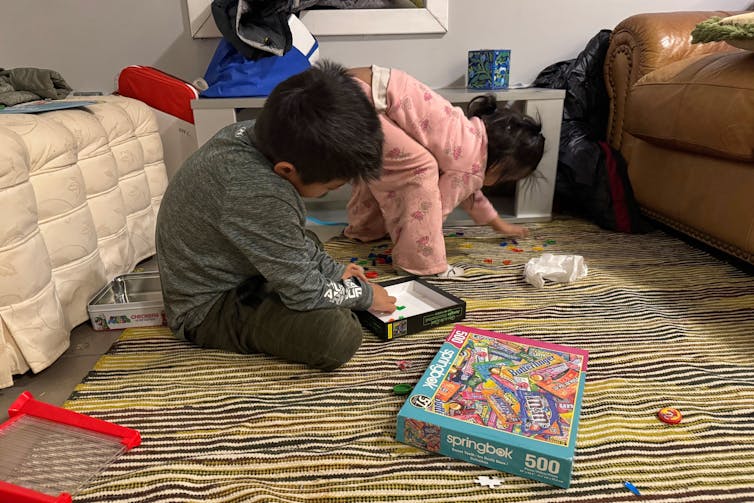 Two immigrant children play in a safe house in Minneapolis in January 2026 after volunteers relocated them from their home to protect them from federal agents.
(AP Photo/Jack Brook)
Two immigrant children play in a safe house in Minneapolis in January 2026 after volunteers relocated them from their home to protect them from federal agents.
(AP Photo/Jack Brook)
Preventing violence against children
Violence against children is a global crisis. Without a seismic shift in how states take action to prevent such violence, the costs will continue to impact people around the world.
As a global community, we have a collective responsibility to build communities where children are not only safe and thriving, but where their capacity and agency as future peace-builders, leaders and decision-makers in their families, schools and communities are built upon and nurtured in wartime and post-conflict societies. These are core responsibilities that the global community is failing at miserably.
As many as 520 million war-affected children deserve better.
Canada has a long history of serving as a champion of children’s rights in armed conflict. Canadians have led global initiatives, including leading the first International Conference on War-affected Children, championing the Ottawa Treaty to ban landmines and developing the Vancouver Principles on Peacekeeping and Preventing the Recruitment and Use of Child Soldiers .
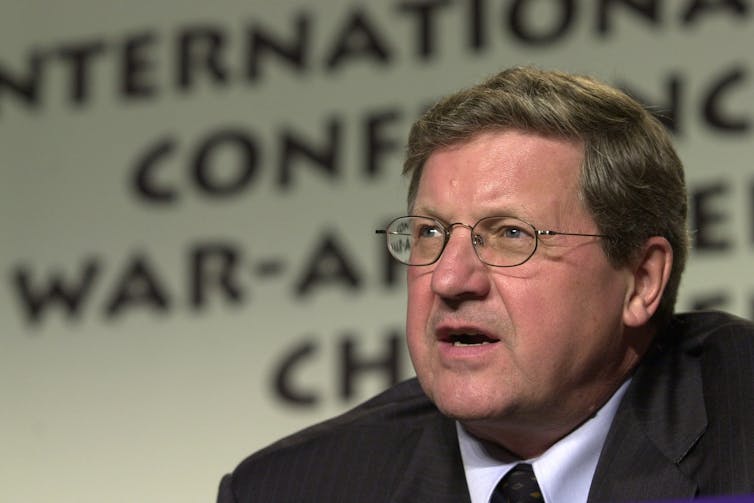 Canada’s foreign affairs minister, Lloyd Axworthy, speaks at The International Conference on War-Affected Children in Winnipeg in September 2000.
THE CANADIAN PRESS/Fred Greenslade
Canada’s foreign affairs minister, Lloyd Axworthy, speaks at The International Conference on War-Affected Children in Winnipeg in September 2000.
THE CANADIAN PRESS/Fred Greenslade
Canada is also the founder and chair of the Group of Friends of Children and Armed Conflict, an informal but vital UN network focused on child protection.
Now more than ever — amid American economic and political disengagement from core child protection priorities — there is both an opportunity and an imperative for Canada to demonstrate active leadership in the promotion of children’s rights and enhanced safety for children impacted by the devastation of armed conflict.
Complacency threatens to perpetuate generational impacts of violence.
Global leadership required
The Canadian government must once again stand up and provide global leadership on children and armed conflict by bolstering strategic alliances and funding efforts to protect and engage children impacted by armed conflict.
As a community of Canadian scholars dedicated to studying children, organized violence and armed conflict, we are deeply concerned about the growing vulnerability of children worldwide.
We see an opportunity for Canada to reclaim its role as a global leader in advancing and protecting children’s rights, especially in a time of political upheaval and heightened global insecurity. Canada can reassert itself and live up to its global reputation as a force for good in the world. It can stand on the global stage and draw attention to a crisis with generational impacts.
Children need protection from the effects of war, but they also need to be seen as active agents of peace who understand their needs and can help secure better futures.
Investments of attention and funding today can make significant differences in the emotional and social development of children who are navigating post-conflict life.
Read more: The lasting scars of war: How conflict shapes children’s lives long after the fighting ends
Canada must take the lead
These investments are critical to the social structures of peaceful communities. Canadian leadership is well-positioned to take on this role, not only because of the country’s history and reputation, but because Canadian scholars are at the forefront, are organized around this issue and can be leveraged for maximum impact.
 Prime Minister Mark Carney speaks during the Annual Meeting of the World Economic Forum in Davos, Switzerland, on Jan. 20, 2026.
(AP Photo/Markus Schreiber)
Prime Minister Mark Carney speaks during the Annual Meeting of the World Economic Forum in Davos, Switzerland, on Jan. 20, 2026.
(AP Photo/Markus Schreiber)
Prime Minister Mark Carney’s recent celebrated speech at the World Economic Forum’s annual conference at Davos signalled a possible and important shift in alliances, priorities and global moral leadership for Canada.
Canadian foreign policy can build upon this. Making the vulnerability of children affected by armed conflict and the capacity of children to be agents of peace a key foreign policy issue would positively affect the lives of millions of children globally. It would also signal to the world that Canada is ready to take on the significant global human rights challenges it once did.
The following scholars, members of The Canadian Community of Practice on Children and Organized Violence & Armed Conflict, contributed to this article: Maham Afzaal, PhD Student, Queens University; Dr. Marshall Beier, McMaster University; Sophie Greco, PhD Candidate, Wilfrid Laurier University; Ethan Kelloway, Honours Student, Mount Saint Vincent University; Dr. Marion Laurence, Dalhousie University; Dr. Kate Swanson, Dalhousie University; Orinari Wokoma, MA student, Mount Saint Vincent University.
- Child soldiers
Events
Jobs
-
 Director of Professional Development
-
Research Fellow in Cybersecurity for Cyber-physical systems
-
University Librarian
-
Video Commissioning Editor
-
Postdoctoral Research Fellow or Research Fellow
 Director of Professional Development
 Research Fellow in Cybersecurity for Cyber-physical systems
 University Librarian
 Video Commissioning Editor
 Postdoctoral Research Fellow or Research Fellow
- Editorial Policies
- Community standards
- Republishing guidelines
- Analytics
- Our feeds
- Get newsletter
- Who we are
- Our charter
- Our team
- Partners and funders
- Resource for media
- Contact us
-
-
-
-
Copyright © 2010–2026, The Conversation