 Vitaly V. Kuzmin/Wikimedia Commons
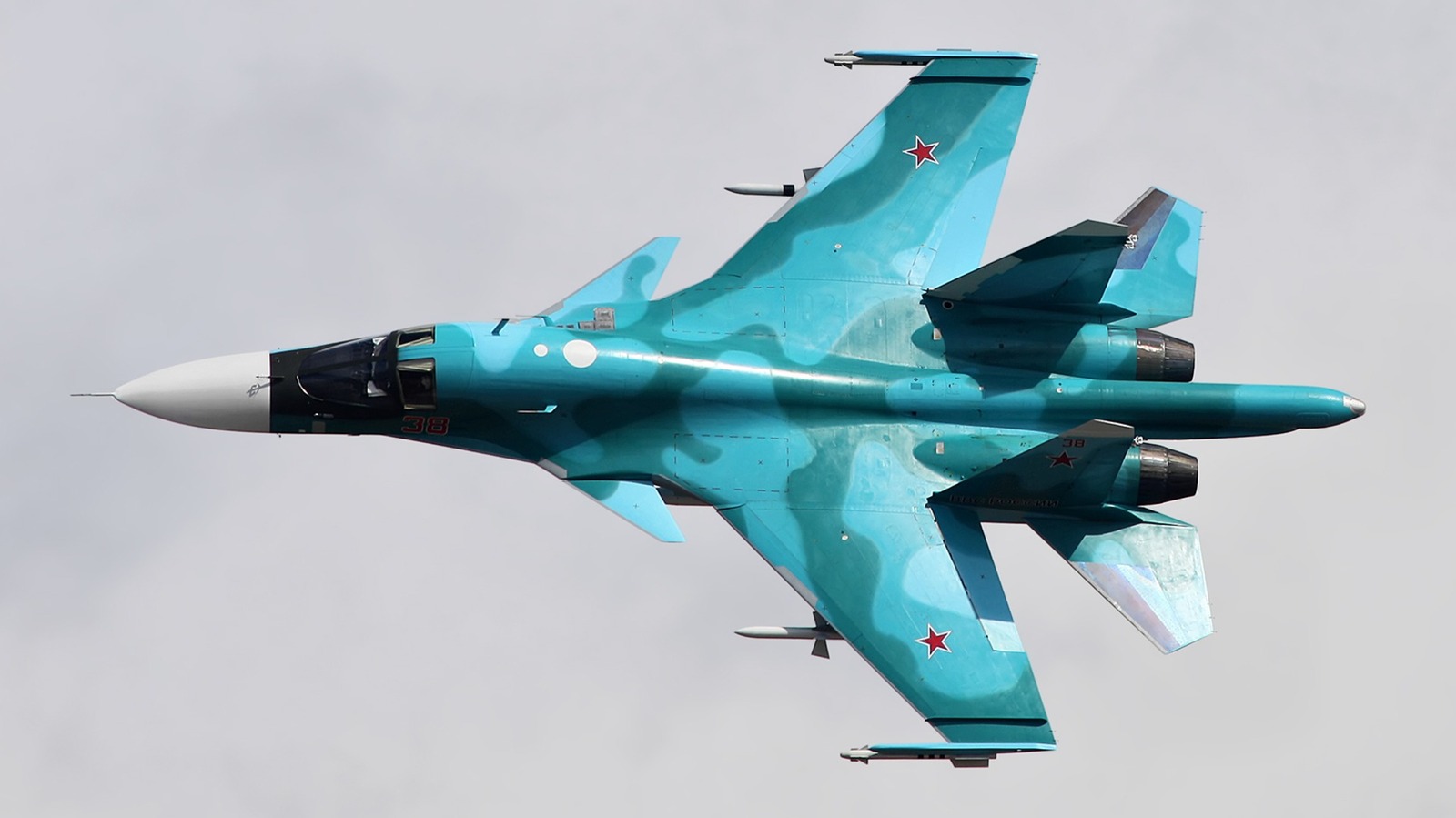
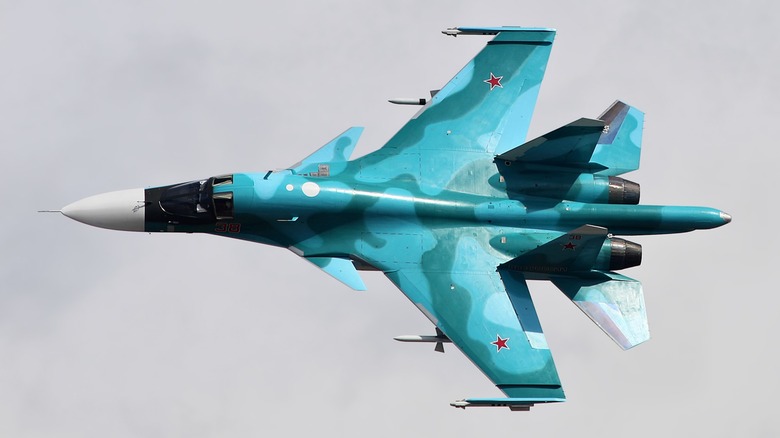
Back during World War II, Adolph Hitler dreamed of bombing the United States, but technology at the time literally couldn't deliver. Nowadays, intercontinental flights are easy, thanks to aerial refueling. That's how most aircraft in the United States Air Force operate, but the Russian Federation's Su-34 is a completely different type of jet. The Su-34 Fullback can fly from Moscow to Washington, D.C. without refueling, which is impressive, seeing as that's a distance of 4,867 miles.
There are several reasons why the Su-34, which Russia has used in the Russo-Ukrainian War, can fly so far. For one, it's a massive aircraft, measuring 76.5 feet in length with a 48-foot wingspan. Under normal operations, it doesn't need to go that far. In cases where it might be needed, it can add three PTB-3000 external fuel tanks to its hard points, which normally accommodate weapons, significantly increasing its range. Each of those tanks holds 793 gallons of fuel, which is added to the bomber's internal fuel capacity.
That fuel capacity gives the Su-34 a ferry range of 2,485 miles. Once you add the external fuel and push the Su-34 to its limits, its range can exceed 4,971 miles. That puts it in range to strike Washington, D.C., though it wouldn't be able to make a return trip home without refueling. Granted, it's unlikely that Russia would ever use its Su-34 fleet in such a manner, but it could, making the Su-34 one of the most powerful non-American fighter jets in service.
The Su-34 is the world's longest-range fighter (currently)
 Ministry of Defence of the Russian Federation/Wikimedia Commons
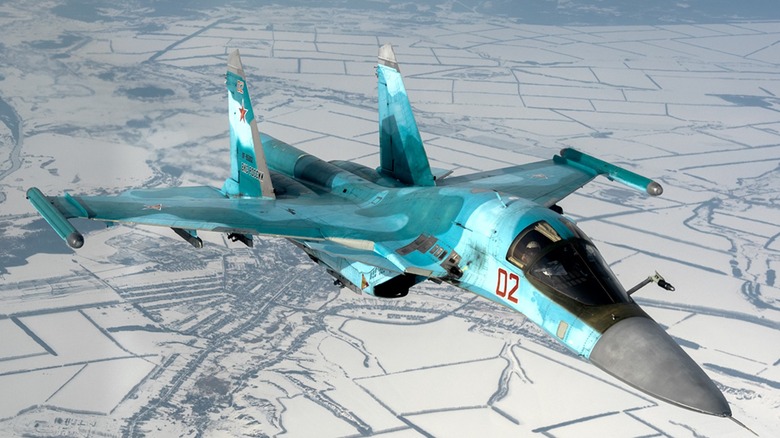
With its added drop tanks, the Su-34 is the world's longest-range fighter, and it's not even close. The United States' longest-range fighter is the F-35C Lightning II, which has an internal fuel capacity of 3,002 gallons. That gives it a range of 1,381 miles. The F-35 doesn't have drop tanks, but they are being designed for the Block 4 upgrade that's expected to be complete no sooner than 2031. Of course, aerial refueling can indefinitely extend the F-35's range.
Still, it pales in comparison to the Su-34. Additionally, the Su-34 will likely receive an upgrade in the form of the AL-51F engine, which was developed for the Su-57 5th-generation fighter. The Su-34 is a 4.5-generation fighter (sometimes referred to as a 4++ generation), thanks to various upgrades that keep it flying. With the introduction of a more fuel-efficient engine, it's likely that the aircraft's range will increase significantly, making it a truly intercontinental strategic aircraft.
The Su-34 first entered the Russian inventory in 1990, and it has a proven track record. While it's unclear how many Russia has, estimates put the Russian Air Force's inventory at around 123 Su-34s. Production continues, and several have been lost in Ukraine, so the total number in the inventory fluctuates over time. Regardless, Russia probably sees a future where the Su-34 remains an important part of its strategic focus, so it's likely that the country will continue producing its intercontinental fighter for the foreseeable future.