- Home
Edition
Africa Australia Brasil Canada Canada (français) Català España Europe France Global Indonesia New Zealand United Kingdom United States Skip to content Edition:
Global
Edition:
Global
- Africa
- Australia
- Brasil
- Canada
- Canada (français)
- Català
- España
- Europe
- France
- Indonesia
- New Zealand
- United Kingdom
- United States
Academic rigour, journalistic flair
How to run a marathon better: the nutritional and psychological hacks that matter most
Published: April 17, 2026 12.20pm BST
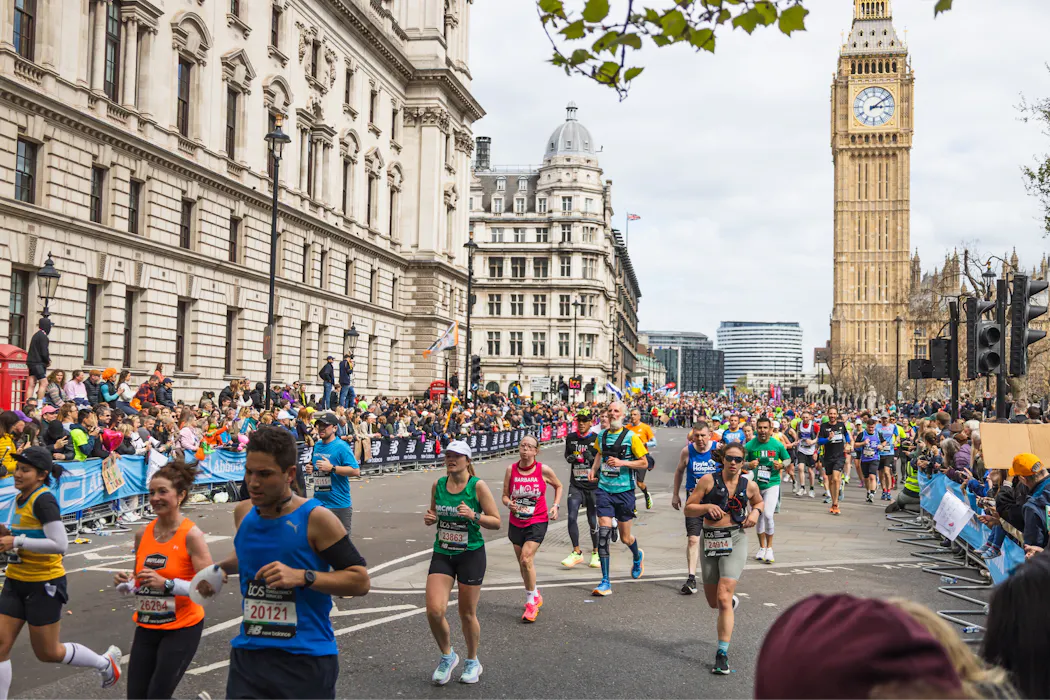
 Successful marathon running isn’t just about fitness.
Tartezy/ Shutterstock
https://theconversation.com/how-to-run-a-marathon-better-the-nutritional-and-psychological-hacks-that-matter-most-279142
https://theconversation.com/how-to-run-a-marathon-better-the-nutritional-and-psychological-hacks-that-matter-most-279142
Link copied
Share article
Successful marathon running isn’t just about fitness.
Tartezy/ Shutterstock
https://theconversation.com/how-to-run-a-marathon-better-the-nutritional-and-psychological-hacks-that-matter-most-279142
https://theconversation.com/how-to-run-a-marathon-better-the-nutritional-and-psychological-hacks-that-matter-most-279142
Link copied
Share article
Share article
Copy link Email Bluesky Facebook WhatsApp Messenger LinkedIn X (Twitter)Print article
Running a marathon asks a great deal of the body. You need sustained energy, careful pacing, plenty of muscle endurance and smart hydration.
Marathons also ask a great deal of the mind. At some point, almost every runner has to deal with nerves, discomfort, self-doubt or the creeping sense that the finish line is still very far away.
That is why successful marathon running is not just about fitness. It’s about fuelling well, thinking clearly and responding effectively when the race starts to bite.
Here are some of the most useful nutritional and psychological strategies to get you through marathon day.
Fuel properly
For runners, carbohydrates are not the enemy. They are the body’s main fuel source at marathon pace. On race day, how and when you take them in matters enormously.
Once the race begins, your glycogen levels (a rapid-release form of energy stored in the body), steadily deplete. For many runners, these reserves begin to run low after roughly two hours of continuous effort, which is one reason people “hit the wall”.
Proper race-day fuelling helps delay that point. Runners should aim to consume around 60 grams of carbohydrate per hour during the race. Gels, chews or sports drinks – often available at aid stations – are great ways of topping up carbohydrate stores. Race day isn’t the moment to gamble, so whatever you plan to use should already be familiar with its effects from training.
Hydration is equally important and just as personal. Some runners lose fluid quickly, while others cannot comfortably drink large amounts while running.
A useful benchmark is try to limit fluid losses to around 2–3% of your body weight during the race. The aim is to replace some of what you’re losing during the race without overdoing it.
One practical approach is to drink to thirst – taking small, regular sips rather than large volumes. This helps avoid both dehydration and the opposite risk, drinking far too much, which can lead to discomfort – or, in rare cases, hyponatraemia (low blood sodium levels).
Finally, remember that fuelling is part of race management. Taking a gel just before a challenging section or grabbing a drink during a quieter stretch can help you manage the miles more effectively.
Enjoy the atmosphere
Marathons offer a one-in-a-lifetime experience for many of us.
The crowds, noise, music, volunteers and sheer occasion can all work in the runner’s favour. Psychologically, this can help shift attention away from the discomfort you may experience during the race.
So do not be afraid to take the day in. Smile at spectators. Acknowledge the cheers. Let yourself be lifted by the event.
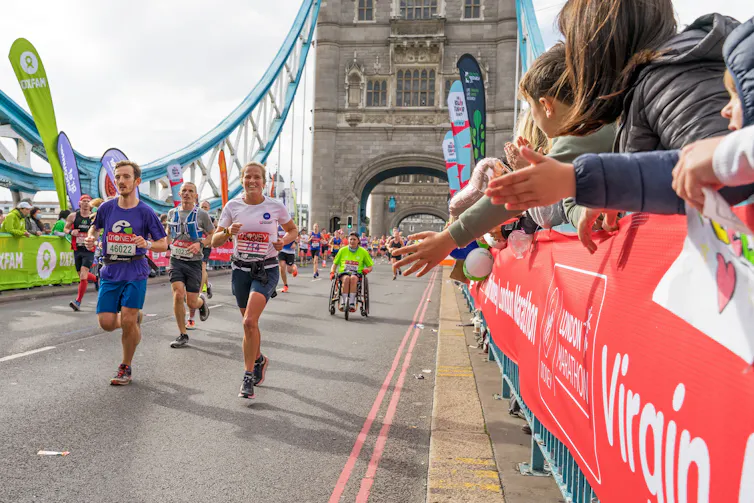 Use the exciting atmosphere to your advantage.
Travers Lewis/ Shutterstock
Use the exciting atmosphere to your advantage.
Travers Lewis/ Shutterstock
That said, excitement can also be costly. A marathon punishes early over-confidence. The occasion may tempt you to run faster than planned, especially in the opening miles when adrenaline is high and the legs still feel fresh.
The best marathoners are not those who ignore the noise. They are often the ones who use it well while still listening to their bodies.
Remember your motivation
For many runners, the marathon is about much more than a finishing time. Some are running for a cause close to their heart, as way of connecting with someone or proving something to themselves.
That deeper reason matters, especially when the race becomes difficult. Be clear about why you are doing it. If nerves surface at the start line or the pain surfaces at the harder miles late on, reconnecting with that reason can help steady the mind and restore perspective.
At those moments, one of the most powerful thoughts can be a very simple one: it’s a big race but the race is not bigger than me.
Be kind to yourself
Most runners will have a difficult patch at some point in the race. That does not mean the marathon is going badly. This is just the reality of running a marathon.
This is where your internal dialogue matters.
Before race day, decide what you want to say to yourself when things get hard. The most effective phrases are usually not dramatic. They are believable, calming and constructive, such as: I’ve trained for this. Keep moving. This is tough, but so am I.
Write the phrase down, maybe keep it with you on race day. Use it when the doubts arrive. Positive affirmations are deemed to be helpful in tough and pressurised sporting situations.
One of the most valuable psychological skills in endurance sport is not pretending the challenge does not exist. It’s responding well when it does.
Because in the end, marathon running is not just about getting to the finish. It is about how you fuel, think and cope along the way.
- Fitness
- Running
- London Marathon
- Marathon
Authors
-
 Andy Galbraith
Associate Professor, University of East London
-
James Beale
Senior Lecturer in Sport Psychology, University of East London
Disclosure statement
The authors do not work for, consult, own shares in or receive funding from any company or organisation that would benefit from this article, and have disclosed no relevant affiliations beyond their academic appointment.
Partners

University of East London provides funding as a member of The Conversation UK.
View all partners
DOI
https://doi.org/10.64628/AB.3x37xp3cq
Events
Jobs
-

Research Assistant, Energy Storage
-
Executive Director, Future Students | UTS College
-
Research Assistant
-
Visiting Professor - 2027 Australia-Korea Chair in Australian Studies at Seoul National University
-
Politics & Society Editor (UK Edition)




- Editorial Policies
- Community standards
- Republishing guidelines
- Analytics
- Our feeds
- Get newsletter
- Who we are
- Our charter
- Our team
- Partners and funders
- Resource for media
- Contact us
-
-
-
-
Copyright © 2010–2026, The Conversation