
- Home
Edition
Africa Australia Brasil Canada Canada (français) Català España Europe France Global Indonesia New Zealand United Kingdom United States Skip to content Edition:
Global
Edition:
Global
- Africa
- Australia
- Brasil
- Canada
- Canada (français)
- Català
- España
- Europe
- France
- Indonesia
- New Zealand
- United Kingdom
- United States
Academic rigour, journalistic flair
 The pandemic created a real-world stress test for schools. Students in an elementary school get ready for class in Montréal in January 2022.
THE CANADIAN PRESS/Paul Chiasson
What Canada, the U.K. and other G7 nations learned about building resilient education systems during the COVID‑19 pandemic
Published: April 19, 2026 2.52pm BST
https://theconversation.com/what-canada-the-u-k-and-other-g7-nations-learned-about-building-resilient-education-systems-during-the-covid-19-pandemic-278367
https://theconversation.com/what-canada-the-u-k-and-other-g7-nations-learned-about-building-resilient-education-systems-during-the-covid-19-pandemic-278367
Link copied
Share article
The pandemic created a real-world stress test for schools. Students in an elementary school get ready for class in Montréal in January 2022.
THE CANADIAN PRESS/Paul Chiasson
What Canada, the U.K. and other G7 nations learned about building resilient education systems during the COVID‑19 pandemic
Published: April 19, 2026 2.52pm BST
https://theconversation.com/what-canada-the-u-k-and-other-g7-nations-learned-about-building-resilient-education-systems-during-the-covid-19-pandemic-278367
https://theconversation.com/what-canada-the-u-k-and-other-g7-nations-learned-about-building-resilient-education-systems-during-the-covid-19-pandemic-278367
Link copied
Share article
Share article
Copy link Email Bluesky Facebook WhatsApp Messenger LinkedIn X (Twitter)Print article
By a dictionary definition, the word resilient means an ability to recover from or adjust easily to misfortune or change. The key words here? “Recover” and “change.”
The notion that psychological characteristics strongly influence resilience is likely familiar to many of us, influenced through mental health or popular discussion.
But in education, resilience should mean more than simply coping with difficulty. It should describe whether students can keep learning, stay motivated and remain connected to school even when their lives are disrupted by crisis, poverty or uncertainty.
From an education perspective, resilience largely pertains to understanding how well students from economically disadvantaged backgrounds perform in traditional subjects like reading, mathematics and science compared to their more affluent peers.
That definition matters, because it reminds us that resilience is not just an individual trait. It is also shaped by schools, families, public policy and the support systems surrounding children. Some students are asked to overcome or recover from much more than others.
What policies help promote student resilience in education systems?
Our research tackled this question by examining how well students responded to the adversity of the COVID-19 pandemic and how effective government policies were in reducing long-term negative impacts.
We compared Canada, the United Kingdom, France, Germany, Italy, Sweden, the Netherlands, Belgium and Japan — the G10 nations, minus Switzerland and the United States.
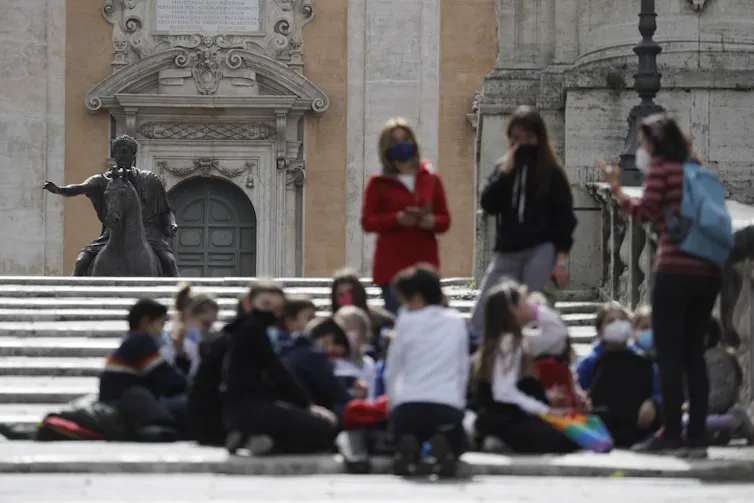 Elementary school children attend an outdoor class with their teacher on the steps leading to Rome’s Capitol Hill in April 2021.
(AP Photo/Gregorio Borgia)
Elementary school children attend an outdoor class with their teacher on the steps leading to Rome’s Capitol Hill in April 2021.
(AP Photo/Gregorio Borgia)
Relationship of ‘soft skills’ to achievement?
There appears to be a disconnect between popular and educational notions of resilience, since the former focuses on “non-cognitive” skills — what many might think of as “soft skills” or “socio-emotional skills” — and the latter focuses on achievement.
In practice, however, these two ideas cannot be separated. A student’s confidence, sense of belonging, emotional stability, perseverance and ability to adapt, all influence academic performance. Likewise, repeated academic struggles can weaken well-being and increase disengagement from school.
Read more: Concerned about student mental health? How wellness is related to academic achievement
Our previous research suggested students with stronger non-cognitive skills perform one full year higher in mathematics, and 1.5 years years higher in reading and science, than students with weaker non-cognitive skills.
Clearly, student achievement and the development of non-cognitive skills should be complementary objectives in education systems. That is an important message for policymakers. Too often, education debates force a false choice between raising test scores and supporting well-being. The evidence suggests that systems that neglect one will ultimately undermine the other.
The pandemic stress test
The pandemic created a real-world stress test for schools. It exposed which systems were able to respond quickly, protect vulnerable learners and adapt to new forms of teaching, and which systems were less prepared.
The lessons remain highly relevant today because the academic and emotional aftershocks of COVID-19 have not fully disappeared.
We want to discuss what we learned about national and provincial education policies that work best. Across the very different systems we examined, one broad conclusion stood out: resilience does not happen by accident. It must be designed into education policy through targeted support, early identification of need and sustained investment in students and teachers.
1) Targeted policies
When students are struggling in school, personalized academic supports such as the U.K.’s National Tutoring Programme, France’s intensive tutoring programs or Germany’s remedial education programs were particularly effective.
The implication is fairly clear: education systems should direct resources where they are needed most and avoid funding models that fail to account for the different needs of students and schools. This is especially true because the pandemic did not affect all children equally.
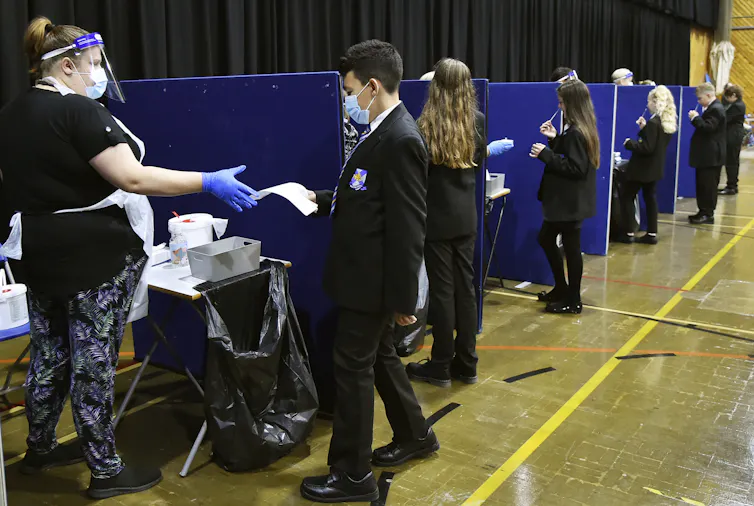 The pandemic didn’t affect all children equally. Students at a COVID-19 test station at at Wales High school, Sheffield, England, in September 2021.
(AP Photo/Rui Vieira)
The pandemic didn’t affect all children equally. Students at a COVID-19 test station at at Wales High school, Sheffield, England, in September 2021.
(AP Photo/Rui Vieira)
Students from disadvantaged families, those with fewer digital resources and those already at risk of falling behind often experienced the largest learning losses.
Universal support has value, but targeted interventions are usually more efficient and more equitable. Small-group tutoring, structured catch-up programs and direct outreach to families can make the difference between temporary disruption and permanent educational damage.
2) Mental-health policies
Supporting student mental health must accompany academic support. The latter was clear from differences observed between Belgium and Japan. Belgium demonstrated the value of proactive mental health interventions while Japan recorded an alarming increase in youth suicides. Clearly, Japan’s academic achievement objectives must also be met with an urgent need for comprehensive mental health strategies. This is not a secondary issue.
Read more: Suicide prevention: Protective factors can build hope and mitigate risks
Schools are not only places of instruction; they are social environments where children build friendships, establish routines and develop a sense of belonging. When those connections are weakened, learning suffers too.
Education recovery plans should include school-based counselling, teacher training to recognize distress and preventive interventions that strengthen peer relationships and student engagement. A resilient education system is one that protects both minds and futures.
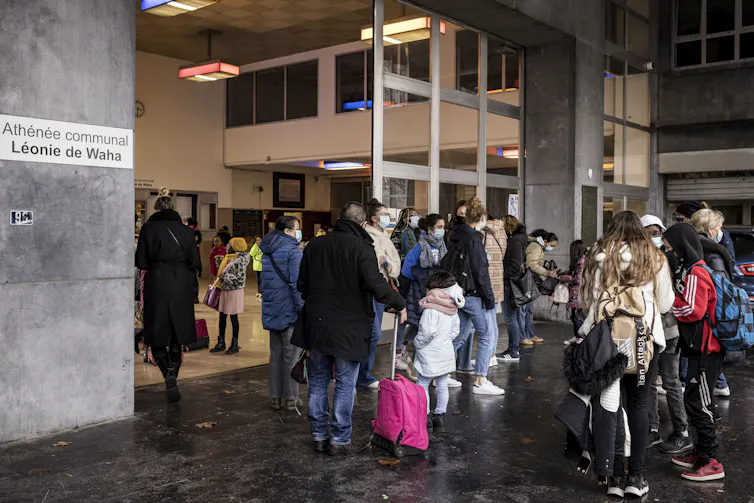 Students of the school Athenee Leonie de Waha leave at the end of their classes in Liege, Belgium, in January 2021. Fed up with the COVID-19 restrictions keeping them at home most of the time, students in the last two years of high school in the city of Liege launched an online petition asking for more in-person class time.
(AP Photo/Valentin Bianchi)
Students of the school Athenee Leonie de Waha leave at the end of their classes in Liege, Belgium, in January 2021. Fed up with the COVID-19 restrictions keeping them at home most of the time, students in the last two years of high school in the city of Liege launched an online petition asking for more in-person class time.
(AP Photo/Valentin Bianchi)
3) Data collection and monitoring policies
Education systems that collect and monitor detailed data on their student population are better positioned to track both cognitive and non-cognitive outcomes and respond accordingly. The Netherlands is one example of a country that maintains robust longitudinal data. Conversely, across Canada’s decentralized education systems, select provinces experienced significant gaps in data collection, particularly for special education student populations.
Read more: Children with special health needs are more likely to come from poorer neighbourhoods
Without reliable data, policymakers are often flying blind. They cannot easily identify who has fallen behind, which interventions are working or whether inequalities are widening.
Better data systems do not mean more bureaucracy for its own sake. They mean better tools for timely action, better accountability for public spending and better protection for students who might otherwise be overlooked.
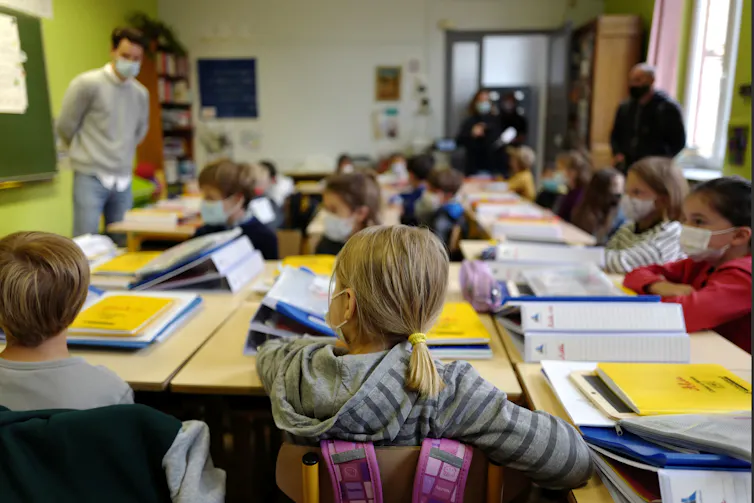 Students attend class on the first day of school for the 2021-2022 year at Gounod Lavoisier Primary school in Lille, northern France, in September 2021.
(AP Photo/Michel Spingler)
Students attend class on the first day of school for the 2021-2022 year at Gounod Lavoisier Primary school in Lille, northern France, in September 2021.
(AP Photo/Michel Spingler)
Supporting students today
Collectively, our cross-national research suggests that education policies matter. Organizational structures, supports and governance approaches have the power to help or hinder the development of resilient education systems.
Although the pandemic may seem like a distant memory, many of the long-term impacts remain. These ongoing challenges to cognitive and non-cognitive student development have also been met with new academic integrity concerns related to the proliferation of artificial intelligence (AI) applications in schools. Future research will need to better understand how AI, and associated policies, are shaping both academic achievement and non-cognitive skills.
The challenge for education systems now is not simply to “return to normal,” but to build something stronger than what existed before. Academic resilience should be understood as the capacity of schools to help all students recover, adapt and thrive.
If policymakers take seriously the lessons of the pandemic, they will recognize that resilience requires targeted learning support, investment in mental health, strong data systems and thoughtful digital strategies. These are not temporary fixes. They are the foundations of a fairer and more future-proof education system.
- Soft skills
- COVID-19 and education
Authors
-
 Louis Volante
Distinguished Professor, Faculty of Education, Brock University
-
Kristof De Witte
Professor in Education Economics, KU Leuven
-
Luca Salmieri
Professor of Sociology of education, Sapienza University of Rome
-
Orazio Giancola
Associate Professor, Sapienza University of Rome
Disclosure statement
Louis Volante receives funding from the Social Sciences and Humanities Research Council of Canada (SSHRC).
Kristof De Witte receives funding from Horizon Europe EFFEct grant (101129146). Views and opinions expressed are however those of the author(s) only and do not necessarily reflect those of the European Union or the granting authority. Neither the European Union nor the granting authority can be held responsible for them.
Luca Salmieri and Orazio Giancola do not work for, consult, own shares in or receive funding from any company or organisation that would benefit from this article, and have disclosed no relevant affiliations beyond their academic appointment.
Partners

Brock University provides funding as a member of The Conversation CA-FR.
Brock University provides funding as a member of The Conversation CA.
View all partners
DOI
https://doi.org/10.64628/AAM.ktf7vq59q
Events
Jobs
-

Research Assistant, Energy Storage
-
Executive Director, Future Students | UTS College
-
Research Assistant
-
Visiting Professor - 2027 Australia-Korea Chair in Australian Studies at Seoul National University



- Editorial Policies
- Community standards
- Republishing guidelines
- Analytics
- Our feeds
- Get newsletter
- Who we are
- Our charter
- Our team
- Partners and funders
- Resource for media
- Contact us
-
-
-
-
Copyright © 2010–2026, The Conversation