- Pro
Your phone, watch, and earbuds could all contribute to a shared AI experience
When you purchase through links on our site, we may earn an affiliate commission. Here’s how it works.
 (Image credit: Future)
- Copy link
- X
- Threads
Sign up to the TechRadar Pro newsletter to get all the top news, opinion, features and guidance your business needs to succeed!
Become a Member in Seconds
Unlock instant access to exclusive member features.
Contact me with news and offers from other Future brands Receive email from us on behalf of our trusted partners or sponsors By submitting your information you agree to the Terms & Conditions and Privacy Policy and are aged 16 or over.You are now subscribed
Your newsletter sign-up was successful
Join the club
Get full access to premium articles, exclusive features and a growing list of member rewards.
Explore An account already exists for this email address, please log in. Subscribe to our newsletter- Combined device AI compute could exceed 1,000 TOPS by the decade's end
- Smartphones, wearables, and earbuds are becoming key distributed AI processors
- Average users likely carry hundreds of TOPS across multiple personal devices
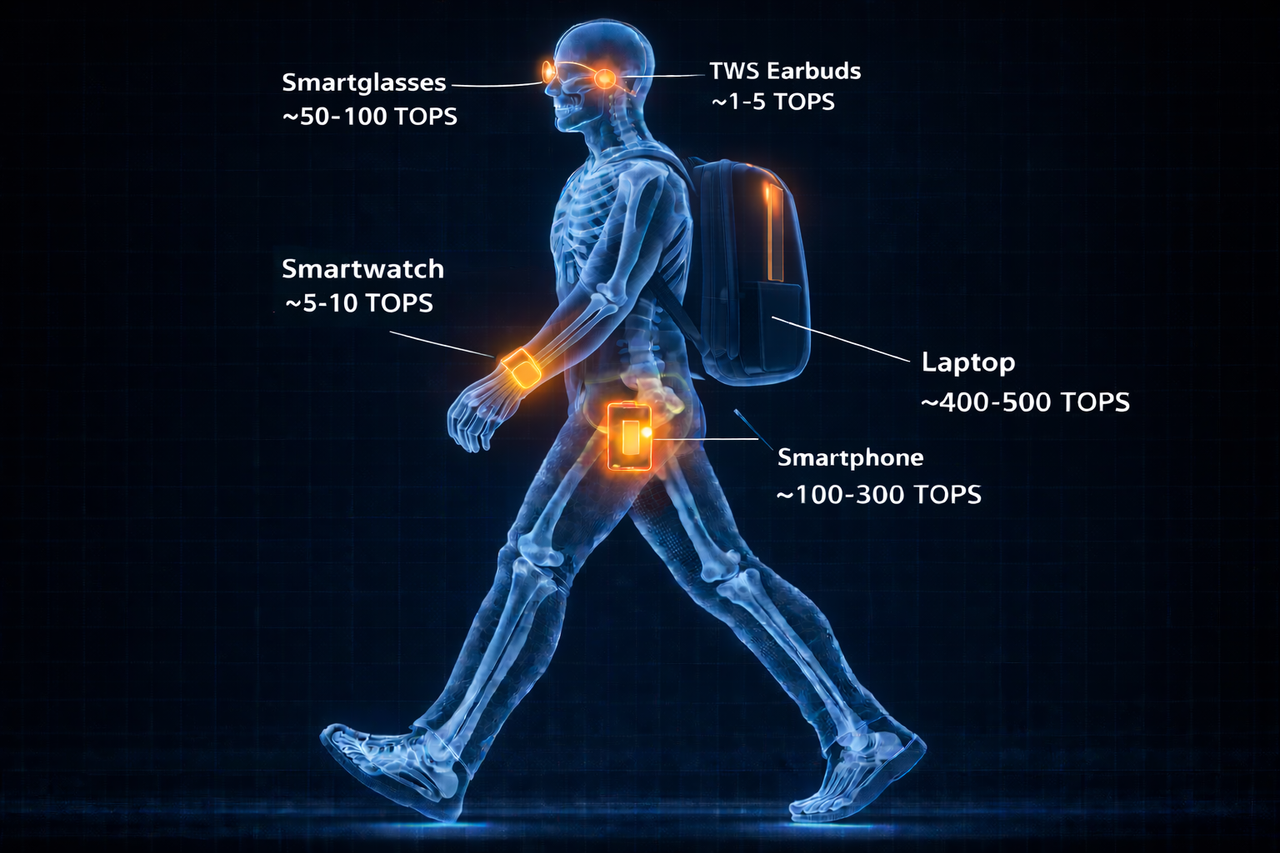
Personal electronics are heading toward a point where combined AI compute across everyday devices rivals systems that once filled dedicated facilities, according to a Futuresource CE analysis tracking edge AI silicon trends through 2030.
The report examines how neural processors are spreading across smartphones, wearables, and audio devices, and how performance growth across those categories could change our expectations for personal computing power.
Smartphones are, naturally, central to all this, with flagship chips from companies such as Qualcomm, MediaTek, Samsung, and Apple now delivering up to 100 TOPS of neural processing capability.
Article continues below You may like-
 AMD's new Ryzen AI 400 CPUs prioritize AI skills over GPU power
-
 Your next device will be an AI PC, if Intel has anything to do with it — chipmaker predicts more than half of PCs shipped this year will be AI-enabled
-
 Qualcomm’s Snapdragon Wear Elite aims to power the next wave of AI wearables — not just smartwatches
Growing NPU performance
Forecasts suggest smartphones alone could nearly triple their NPU performance by the end of the decade.
Smartwatches are no longer trailing quietly behind smartphones either, as dedicated neural processors are beginning to appear in smartwatch chips, a step beyond earlier designs that relied heavily on shared processing blocks.
Shipments of smartwatches reached about 94 million units globally in 2025, showing how widespread they now are.
Wireless earbuds are becoming ever more popular too, with 360 million units shipped annually. Each earbud carries its own chip, so the silicon footprint reaches well over 700 million units every year.
Are you a pro? Subscribe to our newsletterContact me with news and offers from other Future brandsReceive email from us on behalf of our trusted partners or sponsorsBy submitting your information you agree to the Terms & Conditions and Privacy Policy and are aged 16 or over.That spread of AI-capable hardware across multiple devices supports a broader vision often described as the “walking supercomputer.”
“These are not speculative scenarios,” Simon Forrest, Head of Core Technology at Futuresource Consulting, said. “They are the logical product of chip design trends already in motion. Edge AI offers real advantages in speed, privacy and cost, and traditional coded algorithms are being replaced by machine learned versions that increase efficiency while expanding capabilities. For CE brands, understanding where AI compute is heading, and what the silicon enables, is becoming a fundamental strategic necessity.”
Forrest told us that it would be feasible for someone in 2030 to be carrying personal electronics with a combined AI compute exceeding 1,000 TOPS (1 POPS), although it wouldn't be commonplace.
What to read next-
 Maia 200 points to a future where laptops aren’t held hostage by AI
-
 Apple reportedly working on AI smart glasses, an AI pin, and AirPods that can see
-
 “The AI data centers of 2036 won’t be filled with GPUs”: FuriosaAI’s CEO on the future of silicon
He said, “Futuresource forecast modelling shows the average is more likely to be in the range of 450 to 550 TOPS by the end of the decade, assuming a person carries a smartphone, laptop, smartwatch, plus smart glasses and perhaps one other wearable device. Nevertheless, this is still a significant amount of distributed AI computation capacity positioned in and around the body.”
When combined with advances in laptops, smart glasses, and wearables, the aggregate compute figure is becoming more widely discussed alongside single-device performance.
Marketing language often leans on headline TOPS figures, although raw numbers alone don’t capture real-world performance. Architecture design, memory bandwidth, and software optimization remain just as important when translating theoretical compute into practical AI tasks.
The move toward distributed processing across multiple devices is reducing reliance on cloud services, improving response times, and keeping sensitive data closer to the device itself.

Follow TechRadar on Google News and add us as a preferred source to get our expert news, reviews, and opinion in your feeds.
TOPICS AI CATEGORIES AI Platforms & Assistants Wayne WilliamsSocial Links NavigationEditor
Wayne Williams is a freelancer writing news for TechRadar Pro. He has been writing about computers, technology, and the web for 30 years. In that time he wrote for most of the UK’s PC magazines, and launched, edited and published a number of them too.
View MoreYou must confirm your public display name before commenting
Please logout and then login again, you will then be prompted to enter your display name.
Logout Read more
CPU
AMD's new Ryzen AI 400 CPUs prioritize AI skills over GPU power
Pro
Your next device will be an AI PC, if Intel has anything to do with it — chipmaker predicts more than half of PCs shipped this year will be AI-enabled
Smartwatches
Qualcomm’s Snapdragon Wear Elite aims to power the next wave of AI wearables — not just smartwatches
AI Platforms & Assistants
Maia 200 points to a future where laptops aren’t held hostage by AI
Smartwatches
Apple reportedly working on AI smart glasses, an AI pin, and AirPods that can see
Pro
“The AI data centers of 2036 won’t be filled with GPUs”: FuriosaAI’s CEO on the future of silicon
Latest in Pro
 Security
Robots are fighting wars and helping to quash riots — China is arming riot police with squads of AI controlled drones and Ukraine wants to man the frontlines with 25,000 robots
Security
Robots are fighting wars and helping to quash riots — China is arming riot police with squads of AI controlled drones and Ukraine wants to man the frontlines with 25,000 robots
 Security
Struggling to launch Teams? Microsoft recalls update causing failed startup and infinite loading loops – here's what we know
Security
Struggling to launch Teams? Microsoft recalls update causing failed startup and infinite loading loops – here's what we know
 Pro
Adobe Summit 2026: we're live at Adobe's annual keynotes to hear what's new this year
Pro
Adobe Summit 2026: we're live at Adobe's annual keynotes to hear what's new this year
 Security
US security agency still using Mythos despite ban – government using new security tool despite Pentagon's 'supply chain risk' designation
Security
US security agency still using Mythos despite ban – government using new security tool despite Pentagon's 'supply chain risk' designation
 Pro
How hackers 'trojan-horsed' QEMU virtual machines to bypass security and drop ransomware
Pro
How hackers 'trojan-horsed' QEMU virtual machines to bypass security and drop ransomware
 Pro
The AI trust advantage: How smarter security wins customer confidence
Latest in News
Pro
The AI trust advantage: How smarter security wins customer confidence
Latest in News
 Phones
Tim Cook stepping down at Apple, John Ternus will become new CEO
Security
Robots are fighting wars and helping to quash riots — China is arming riot police with squads of AI controlled drones and Ukraine wants to man the frontlines with 25,000 robots
Phones
Tim Cook stepping down at Apple, John Ternus will become new CEO
Security
Robots are fighting wars and helping to quash riots — China is arming riot police with squads of AI controlled drones and Ukraine wants to man the frontlines with 25,000 robots
 Hybrid & Electric Vehicles
Hyundai's compact-but-roomy Ioniq 3 wants to reboot the electric hatchback
Hybrid & Electric Vehicles
Hyundai's compact-but-roomy Ioniq 3 wants to reboot the electric hatchback
 VPN Services
Proton VPN usage spikes in Turkey following new regulatory proposals
VPN Services
Proton VPN usage spikes in Turkey following new regulatory proposals
 AI Platforms & Assistants
ChatGPT was down for many — as OpenAI says it's 'monitoring the recovery'
AI Platforms & Assistants
ChatGPT was down for many — as OpenAI says it's 'monitoring the recovery'
 iPhone
iOS 27 reportedly won't come to four iPhone models
LATEST ARTICLES
iPhone
iOS 27 reportedly won't come to four iPhone models
LATEST ARTICLES- 1Quordle hints and answers for Tuesday, April 21 (game #1548)
- 2NYT Connections hints and answers for Tuesday, April 21 (game #1045)
- 3NYT Strands hints and answers for Tuesday, April 21 (game #779)
- 4How hackers 'trojan-horsed' QEMU virtual machines to bypass security and drop ransomware
- 5Scientists load the first complete genome into a quantum computer