
- Home
Edition
Africa Australia Brasil Canada Canada (français) Català España Europe France Global Indonesia New Zealand United Kingdom United States Skip to content Edition:
Global
Edition:
Global
- Africa
- Australia
- Brasil
- Canada
- Canada (français)
- Català
- España
- Europe
- France
- Indonesia
- New Zealand
- United Kingdom
- United States
Academic rigour, journalistic flair
 Hezbollah still retains a degree of support, particularly among those Shia muslims returiing to a devastated southern Lebanon.
AP Photo/Bilal Hussein
Israel’s onslaught against Lebanon may strengthen Hezbollah – just when it’s at its weakest
Published: April 20, 2026 3.10pm BST
https://theconversation.com/israels-onslaught-against-lebanon-may-strengthen-hezbollah-just-when-its-at-its-weakest-281031
https://theconversation.com/israels-onslaught-against-lebanon-may-strengthen-hezbollah-just-when-its-at-its-weakest-281031
Link copied
Share article
Hezbollah still retains a degree of support, particularly among those Shia muslims returiing to a devastated southern Lebanon.
AP Photo/Bilal Hussein
Israel’s onslaught against Lebanon may strengthen Hezbollah – just when it’s at its weakest
Published: April 20, 2026 3.10pm BST
https://theconversation.com/israels-onslaught-against-lebanon-may-strengthen-hezbollah-just-when-its-at-its-weakest-281031
https://theconversation.com/israels-onslaught-against-lebanon-may-strengthen-hezbollah-just-when-its-at-its-weakest-281031
Link copied
Share article
Share article
Copy link Email Bluesky Facebook WhatsApp Messenger LinkedIn X (Twitter)Print article
As the tentative ceasefire in Lebanon holds, people are returning to their homes in the south to find widespread destruction. Whole villages laid waste, roads and bridges ruined, hospitals and other civic infrastructure flattened. And the Israeli army still very much in evidence in many areas.
The most recent conflict between Israel and Lebanon has killed more than 2,100 people and displaced more than a million more. Israel’s stated aim is to destroy Hezbollah, which it describes as an Iranian proxy. But this is a misleading framing of the situation. And trying to destroy Hezbollah by attacking and occupying Lebanon is a dangerous misreading of the situation.
Hezbollah, the so-called “Party of God”, is not the same thing as Lebanon. Yet the party is deeply embedded in Lebanese politics. The group emerged during the Lebanese civil war and in the aftermath of Israel’s 1982 invasion. It grew rapidly by combining armed resistance with political representation and services for Shia communities that had long been neglected by the Lebanese state.
In the southern suburbs of Beirut, known as Dahiyeh, and across the south, it became a provider of services. Hezbollah built schools, clinics and welfare networks that helped it convert resistance into social legitimacy. That presence built loyalty and dependence that outlasted its original resistance role.
Lebanon’s postwar political system is built on sectarian power sharing. Hezbollah entered parliament in the 1990s and built alliances well beyond its core Shia base, which enabled it to join coalition governments.
But unlike other major Lebanese factions, it retained its weapons after the civil war. This allowed it to combine formal political participation with an armed capacity that was outside the control of the state. Its alliance with Christian groups, most significantly Free Patriotic Movement, Lebanon’s largest Christian party, gave it cross-sectarian legitimacy and protection against isolation.
Hezbollah’s ability to shape Lebanese politics has often rested less on governing than on stopping other groups from governing. The clearest illustration was the presidency. After Michel Aoun completed his term in October 2022, Lebanon went without a president for more than two years. Hezbollah blocked every candidate that threatened its interests. Parliament failed to elect a successor 13 times.
Lebanon drifted without a head of state through the 2024 war with Israel. Its caretaker government could not take major decisions. Desperately needed economic assistance was withheld by international donors. It was Hezbollah’s blocking power made visible. Lebanon’s caretaker government could not take major decisions or enact the reforms international donors required. Desperately needed economic assistance was withheld as a result.
Hezbollah’s political weakness
This current conflict has caught Hezbollah in a weaker political position than it once enjoyed. The anti-government protests of 2019, economic collapse and the Beirut port explosion has deepened public anger at Lebanon’s ruling class — and at Hezbollah as part of it. Hezbollah’s attempts to obstruct the judicial investigation into the explosion deepened that anger further.
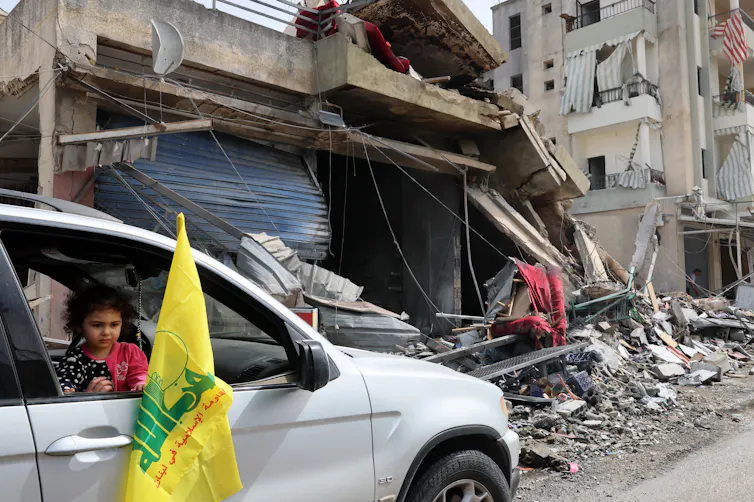 A young girl waves a Hezbollah flag as her family returns home to find southern Lebanon in ruins.
EPA/Wael Hamzeh
A young girl waves a Hezbollah flag as her family returns home to find southern Lebanon in ruins.
EPA/Wael Hamzeh
The 2022 elections confirmed the shift. Hezbollah and its allies lost the majority they had held since 2018. Independents and reformists who emerged out of the protests took seats in a more fragmented legislature.
The Arab Barometer’s 2024 survey found that just 30% of Lebanese expressed significant trust in Hezbollah, with 55% saying they had no trust at all. Hezbollah’s claim to speak for Lebanon — or even for all Lebanese Shia — is now more contested than at any point in its modern history.
The 2024 war, with the devastating pager attacks of September 17 and 18, substantially degraded Hezbollah’s military and further weakened its political standing. Assad’s fall in Syria in December removed a key source of regional support.
In January 2025, the Lebanese parliament finally elected Joseph Aoun as president — something that would have been unthinkable when Hezbollah was at its peak and was able to use its influence to exclude him. Aoun, a former army commander, has always insisted it was the army – not Hezbollah – that should be the defender of Lebanon’s sovereignty.
Operation: destroy Hezbollah
Israel’s stated objective for many years has been to create a more durable security order along its northern border by weakening or dismantling Hezbollah. But, at the same time, Israeli strikes have inflicted devastation far beyond Hezbollah itself, hitting civilians, infrastructure and communities across the country.
The destruction of places such as Dahiyeh reflects a broader logic of warfare in which dense urban space is treated as part of the battlefield. UN experts have argued that the destruction of homes and mass displacement amount to collective punishment in violation of international law.
The argument echoes broader legal debates about Israel’s conduct in Gaza, where UN experts have made similar findings.
That is also why the simple frame of “Israel versus Hezbollah” erases so much. Many of those driven from their homes in the south or in Dahiyeh had grown critical of Hezbollah, or had not chosen this war at all. Yet they found themselves bombed out of neighbourhoods that had been designated as legitimate targets, because of an assumed association with Hezbollah. The civilians killed and displaced are not bystanders to somebody else’s conflict. They are among its principal victims.
A ceasefire was announced on April 17, and – while Hezbollah has not formally endorsed it – the group appears to be observing it for now. Yet the truce leaves the central political question unresolved. Israeli officials have made clear they do not regard it as settling the question of southern Lebanon’s demilitarisation.
Expecting the Lebanese army to dismantle Hezbollah by force is unrealistic. If Hezbollah resisted — and it would — the result could be open civil conflict. It would fracture the army, deepen sectarian tensions, and drive Shia communities back behind the very organisation whose grip had begun to loosen, leaving it politically stronger than it was before the latest round of hostilities.
Any lasting settlement will have to reckon with the reality this war has exposed: Hezbollah is not Lebanon. But at the moment it’s Lebanon which is being punished.
- Hezbollah
- Lebanon
- US-Iran conflict
- Israel-Hezbollah
- Lebanon politics
Author
-
 John Nagle
Professor in Sociology, Queen's University Belfast
Disclosure statement
John Nagle does not work for, consult, own shares in or receive funding from any company or organisation that would benefit from this article, and has disclosed no relevant affiliations beyond their academic appointment.
Partners

Queen's University Belfast provides funding as a founding partner of The Conversation UK.
View all partners
DOI
https://doi.org/10.64628/AB.ejgpjm6qu
Events
Jobs
-

Executive Assistant
-
Research Assistant, Energy Storage
-
Executive Director, Future Students | UTS College
-
Visiting Professor - 2027 Australia-Korea Chair in Australian Studies at Seoul National University



- Editorial Policies
- Community standards
- Republishing guidelines
- Analytics
- Our feeds
- Get newsletter
- Who we are
- Our charter
- Our team
- Partners and funders
- Resource for media
- Contact us
-
-
-
-
Copyright © 2010–2026, The Conversation