- Home
Edition
Africa Australia Brasil Canada Canada (français) Català España Europe France Global Indonesia New Zealand United Kingdom United States Skip to content Edition:
Global
Edition:
Global
- Africa
- Australia
- Brasil
- Canada
- Canada (français)
- Català
- España
- Europe
- France
- Indonesia
- New Zealand
- United Kingdom
- United States
Academic rigour, journalistic flair
There is something wrong with the asylum process for LGBTQ+ people – but it’s not fake claimants
Published: April 20, 2026 2.28pm BST
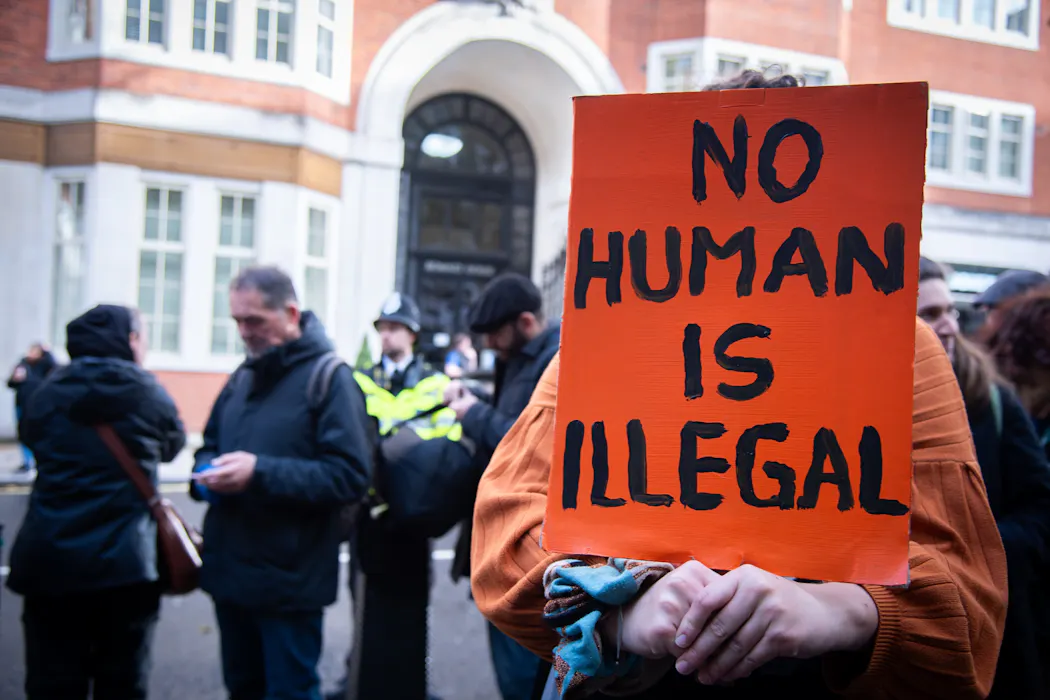
 A 2023 protest against the then-government’s asylum policies.
Loredana Sangiuliano/Shutterstock
https://theconversation.com/there-is-something-wrong-with-the-asylum-process-for-lgbtq-people-but-its-not-fake-claimants-280838
https://theconversation.com/there-is-something-wrong-with-the-asylum-process-for-lgbtq-people-but-its-not-fake-claimants-280838
Link copied
Share article
A 2023 protest against the then-government’s asylum policies.
Loredana Sangiuliano/Shutterstock
https://theconversation.com/there-is-something-wrong-with-the-asylum-process-for-lgbtq-people-but-its-not-fake-claimants-280838
https://theconversation.com/there-is-something-wrong-with-the-asylum-process-for-lgbtq-people-but-its-not-fake-claimants-280838
Link copied
Share article
Share article
Copy link Email Bluesky Facebook WhatsApp Messenger LinkedIn X (Twitter)Print article
An undercover investigation by BBC News has found evidence of people falsely claiming to be gay to gain asylum in the UK. The findings are concerning. But rather than assume this means all asylum applicants are lying, it’s worth asking why people might be drawn to this route.
There is good reason for the UK and other countries to offer refuge to LGBTQ+ asylum seekers. Extensive evidence from organisations such as Human Rights Watch and UNHCR shows that LGBTQ+ people in countries like Pakistan and Bangladesh face imprisonment, family and community violence, police harassment and so-called honour-based abuse. This is precisely why sexual orientation is recognised as a basis for protection in international refugee law.
Sexual orientation claims make up a very small proportion of overall asylum applications. Only 2% of all asylum claims made in 2023 included sexual orientation as part of the reasoning.
Proving to the Home Office that someone is LGBTQ+ isn’t an easy feat. The BBC investigation repeats an adviser’s claim that “there is no check-up”. In reality, the Home Office conducts an intensive refugee status determination process. This involves two interviews, and places the burden of proof on the claimant to show that they require protection from persecution.
In recent years, sexuality in asylum claims has come to be about identity, rather than behaviour. This view – which is often about how people see themselves or what protests or nightclubs they attend – isn’t necessarily consistent with how applicants understand their own sexuality.
Research suggests that decision-makers often rely on narrow, formulaic expectations of how an LGBTQ+ person “should” behave, rather than properly assessing the risk of persecution. For example, one of our research participants, a Ugandan refugee, said that her having been previously married to a man (in a forced marriage), was taken as evidence that she was not a lesbian.
The asylum process makes stereotypical performances of credibility easier to read for decision-makers, compared to the ambivalent and fluid reality of LGBTQ+ lived experience. It privileges linear emotional journeys and open and visible participation in LGBTQ+ spaces. This is often through a western lens of what sexual orientation as an identity means.
For example, research has shown that perceptions of homosexuality being at odds with religion means religious LGBTQ+ asylum seekers face additional suspicion.
This creates incentives for legal experts, charity workers and advisers to package LGBTQ+ claimants into institutionally recognisable categories. In other words, it is the assessment process itself that produces the conditions in which “coached” identities are viewed as a way through the asylum system.
Fabricating a claim is not easy, however: it is risky, expensive and often unsuccessful. One of the BBC’s core examples, “Ali”, was ultimately not successful in securing refugee status in the UK. Since the passage of the Nationality and Borders Act 2022, an even higher standard of proof has applied to all asylum claims.
A culture of disbelief
Research in refugee and migration studies has consistently shown evidence of a widespread culture of disbelief by authorities towards people seeking asylum. This is particularly true in the case of those basing their claims on their sexual orientation.
Asylum systems are sceptical by design. Applicants undergo long, detailed interviews. They must demonstrate consistency and plausibility, and face significant rejection rates. In the UK, the initial grant rate for the year ending December 2025 was 42%, meaning most claims were rejected (many of these are later granted on appeal).
At the same time, a lack of accessible information about the asylum system as well as affordable legal advice and representation mean that applicants are easily misled or exploited by bad faith actors.
Read more: Legal aid for asylum seekers is hard to come by – it’s no wonder criminal advisers are taking advantage
 Charities supporting LGBTQ+ asylum seekers join London’s Pride march.
AVPics/Alamy
Charities supporting LGBTQ+ asylum seekers join London’s Pride march.
AVPics/Alamy
The BBC investigation exposes a handful of cases, but there is no credible evidence that fraudulent claims in this category are widespread. When similar allegations were made by former home secretary Suella Braverman in 2023, the Home Office was unable to provide evidence of systemic abuse.
More than anything, the BBC’s report is evidence of a regulatory issue in the legal system that should be addressed. But it is likely to cast suspicion over LGBTQ+ asylum claims more broadly, reinforcing the idea that people seeking asylum are trying to “game the system”. It says little about the structural conditions that shape these claims in the first place. These include an underfunded legal aid sector, and the lack of safe and managed routes for refugees, forcing people into precarious and informal systems in the first place.
Rather than leading to better decision-making by the Home Office, panic over fake claimants could create a harsher atmosphere where those with well-founded fear of persecution may find it even harder to be protected.
- Asylum
- Asylum seekers
- LGBTQI+
Authors
-
 Raawiyah Rifath
Lecturer in Law, University of Exeter
-
Alex Powell
Associate Professor in Law, University of Warwick
-
Calogero Giametta
Lecturer in Criminology, University of Leicester
Disclosure statement
Raawiyah Rifath has received funding from the Wellcome Centre for Cultures and Environments of Health.
Alex Powell and Calogero Giametta do not work for, consult, own shares in or receive funding from any company or organisation that would benefit from this article, and have disclosed no relevant affiliations beyond their academic appointment.
Partners

University of Warwick provides funding as a founding partner of The Conversation UK.
University of Leicester and University of Exeter provide funding as members of The Conversation UK.
View all partners
DOI
https://doi.org/10.64628/AB.rwrqhhmvm
Events
Jobs
-

Executive Assistant
-
Research Assistant, Energy Storage
-
Executive Director, Future Students | UTS College
-
Visiting Professor - 2027 Australia-Korea Chair in Australian Studies at Seoul National University

- Editorial Policies
- Community standards
- Republishing guidelines
- Analytics
- Our feeds
- Get newsletter
- Who we are
- Our charter
- Our team
- Partners and funders
- Resource for media
- Contact us
-
-
-
-
Copyright © 2010–2026, The Conversation