
- Home
Edition
Africa Australia Brasil Canada Canada (français) Català España Europe France Global Indonesia New Zealand United Kingdom United States Skip to content Edition:
Global
Edition:
Global
- Africa
- Australia
- Brasil
- Canada
- Canada (français)
- Català
- España
- Europe
- France
- Indonesia
- New Zealand
- United Kingdom
- United States
Academic rigour, journalistic flair
 Talking with your child about the world around them is part of what builds their foundation for becoming a confident reader.
(Pexels/Grace)
Starting kindergarten soon? Summer is a perfect time to support your child’s early literacy learning
Published: June 4, 2026 7.13pm BST
https://theconversation.com/starting-kindergarten-soon-summer-is-a-perfect-time-to-support-your-childs-early-literacy-learning-283559
https://theconversation.com/starting-kindergarten-soon-summer-is-a-perfect-time-to-support-your-childs-early-literacy-learning-283559
Link copied
Share article
Talking with your child about the world around them is part of what builds their foundation for becoming a confident reader.
(Pexels/Grace)
Starting kindergarten soon? Summer is a perfect time to support your child’s early literacy learning
Published: June 4, 2026 7.13pm BST
https://theconversation.com/starting-kindergarten-soon-summer-is-a-perfect-time-to-support-your-childs-early-literacy-learning-283559
https://theconversation.com/starting-kindergarten-soon-summer-is-a-perfect-time-to-support-your-childs-early-literacy-learning-283559
Link copied
Share article
Share article
Copy link Email Bluesky Facebook WhatsApp Messenger LinkedIn X (Twitter)Print article
The first day of kindergarten is a momentous occasion for children and families. It’s an exciting milestone that comes with new friends, teachers and learning opportunities.
It can also bring parental anxiety about whether their child is ready, especially when it comes to early literacy. Parents and caregivers can rest assured since they are their child’s first teacher.
Even if a parent isn’t explicitly thinking about what to teach and how to teach it, everyday parent-child interactions foster growth in language and early literacy.
Research shows that early home literacy activities are associated with later reading skills. These activities simply involve talking with your child, describing what you’re doing, asking questions that invite more than a yes or no and following their lead when they say something that interests them.
Below, we highlight five ways parents can incorporate early literacy learning into their everyday interactions this summer.
Sing, rhyme and play with speech sounds
When we sing silly songs, chant rhymes or play with speech sounds by clapping the number of syllables in our names, we’re playing with the sounds of speech.
Through these simple auditory activities, children begin to recognize that spoken words are made up of smaller component parts. Those individual sound parts might be words, syllables or the smallest speech sounds, known as phonemes.
As children notice and manipulate sounds in spoken words, they begin building a foundation for reading and writing. Listening to and singing simple songs, like Down by the Bay or Apples and Bananas by Raffi, allows a child to manipulate sounds in words.
Children who develop this oral foundation are better prepared for reading. Understanding that speech sounds can be divided into smaller sounds helps children break the code of written language or “de-code” words, a foundational part of learning to read.
Read more: Fun with rhymes and word play helps children learn to read
Read together daily
Shared reading is a great way for parents to promote oral language and vocabulary development in a social activity.
Cuddling up to read has been found to change the structure of a child’s brain and how their brains make connections. This seems to be especially true when parents engage in shared reading with illustrated books.
 Shared reading happens when a parent or caregiver reads a book aloud and offers comments and questions about the story, and the child responds.
(Getty Images/Unsplash+)
Shared reading happens when a parent or caregiver reads a book aloud and offers comments and questions about the story, and the child responds.
(Getty Images/Unsplash+)
Research has also found that children who are often read to have larger vocabularies, especially as books become more complex and new words are introduced and discussed.
Get started by going to a local library or hunting for celebrated books at garage sales and thrift stores.
Point out letters and words
Pointing out letters and words in a child’s environment fosters what educators and literacy scholars call print awareness — the understanding that printed letters, words and other symbols carry meaning, and that books contain letters and words.
Print awareness also includes an understanding of what books and other types of texts and media are used for, and how different texts and media work.
As children notice letters, words and symbols in different ways, they come to understand that print has different contextual functions. Menus list food choices, the backs of cereal boxes list ingredients, a book tells a story and a sign can tell us to stop or go.
 Building print awareness might seem intuitive or instinctive, but there is a lot that happens from implicit and explicit modelling, sharing and showing.
(Getty Images/Unsplash+)
Building print awareness might seem intuitive or instinctive, but there is a lot that happens from implicit and explicit modelling, sharing and showing.
(Getty Images/Unsplash+)
Take pictures of signs and labels and talk about what they mean. Pointing out letters, words and also spacing between words and other symbols during everyday life or during shared reading allows children to begin to recognize words and spelling patterns.
Form letters through play
Learning to form the letters of the alphabet (and any sign, symbol or mark) begins with holding a crayon or marker with a full grasp and making what seem like randomly assorted marks or scribbles.
As a child’s fine motor skills develop, they begin to use a stronger grasp to draw and form letters and eventually make words.
Read more: What are motor skills? Evidence-based ways to support children’s fine and gross motor development
The muscles involved in fine motor skills can be strengthened through simple games and activities, like manipulating small blocks or figures, threading beads, squeezing tweezers to pick up small pom poms, playing with playdough or using a stick to draw in sand at the beach.
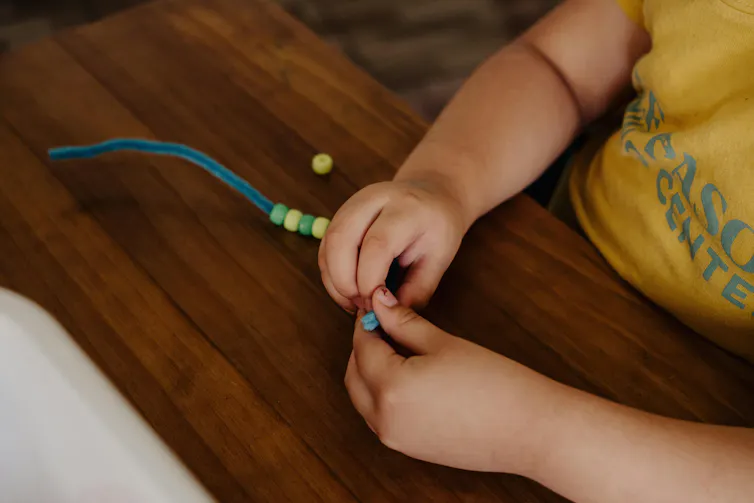 Fine motor skills can be strengthened through simple activities.
(Shelby Murphy Figueroa/Unsplash)
Fine motor skills can be strengthened through simple activities.
(Shelby Murphy Figueroa/Unsplash)
When you take notes by hand, you model printing or writing. Research shows that forming words and taking notes by hand, rather than typing, allows us to remember more of what we’ve written down. Handwriting has also been linked to letter processing, the ability to recognize and identify letters.
Become word scientists
Research shows that promoting an enjoyment in learning about new and interesting words and word parts provides a strong foundation for reading and writing.
Consider all the prefixes that can be added to the beginning of words or all the suffixes that can be added to the end of words to create new ones. You can observe with your child, for example, how the prefix re- means “do again” or “doing an action over” as in the words reheat and rewrite.
An awareness of how words are structured helps children decode words and spelling skills. Your family can all become word scientists by playing word games where you list off or match summer words all ending with the same suffix (for example, you might match the suffix “-est” with the words hottest, sunniest, brightest, breeziest). Or post and use a word-of-the-day (and a picture of that word) on your refrigerator.
You can also keep a word collector — a piece of paper with separated boxes with a different letter of the alphabet in each box. This can be posted on the wall or be kept in a notebook.
 You can build your child’s interest in words by helping them keep a word collector notebook or chart.
(Getty Images/Unsplash)
You can build your child’s interest in words by helping them keep a word collector notebook or chart.
(Getty Images/Unsplash)
New and interesting words that you and your child come across, either through a book being read aloud, during a conversation or while watching a favourite show, can be compiled here.
While reading a story, you might stop at an exciting new word like “magnificent,” repeat the word, talk about its meaning and use the word in a simple sentence (“The view of the lake was magnificent”). You could then add it to your word collector and refer to it later that day or week.
Reading together, telling stories and talking about the world around your child builds their foundation for becoming a confident reader.
The best part is that these interactions serve two important roles: Building early literacy skills and family connection.
By the fall, your child will have spent an entire summer noticing letters, playing with sounds and discovering that books are worth getting excited about — which is exactly the foundation needed for kindergarten.
- Kindergarten
- Parent-child relationships
- Early literacy
- print awareness
- nursery rhymes
Authors
-
 Pamela Beach
Associate Professor, Faculty of Education, Queen's University, Ontario
-
Kristy Timmons
Associate Professor, Early Childhood Education, Queen's University, Ontario
Disclosure statement
The authors do not work for, consult, own shares in or receive funding from any company or organisation that would benefit from this article, and have disclosed no relevant affiliations beyond their academic appointment.
Partners

Queen's University, Ontario provides funding as a founding partner of The Conversation CA.
Queen's University, Ontario provides funding as a member of The Conversation CA-FR.
View all partners
DOI
https://doi.org/10.64628/AAM.5wpnfcvqr
Events
Jobs
-

Deputy Editor, Arts and Culture
-
Forensicare Postdoctoral Research Fellow/Research Fellow
-
Police Cadet, South Australia Police



- Editorial Policies
- Community standards
- Republishing guidelines
- Analytics
- Our feeds
- Get newsletter
- Who we are
- Our charter
- Our team
- Partners and funders
- Resource for media
- Contact us
-
-
-
-
Copyright © 2010–2026, The Conversation