
- Home
Edition
Africa Australia Brasil Canada Canada (français) Català España Europe France Global Indonesia New Zealand United Kingdom United States Skip to content Edition:
Global
Edition:
Global
- Africa
- Australia
- Brasil
- Canada
- Canada (français)
- Català
- España
- Europe
- France
- Indonesia
- New Zealand
- United Kingdom
- United States
Academic rigour, journalistic flair
 Ukraine’s decision to rebury OUN leader Andriy Melnyk with state honours and rename a special forces unit after the wartime Ukrainian Insurgent Army has created a rupture with Poland. Ukraine’s President Volodymyr Zelenskyy speaks during a joint press conference with NATO Secretary General Mark Rutte in Kyiv on June 3, 2026.
(AP Photo/Evgeniy Maloletka)
Zelenskyy’s honouring of wartime nationalists is straining Ukraine’s alliance with Poland
Published: June 4, 2026 6.28pm BST
https://theconversation.com/zelenskyys-honouring-of-wartime-nationalists-is-straining-ukraines-alliance-with-poland-284408
https://theconversation.com/zelenskyys-honouring-of-wartime-nationalists-is-straining-ukraines-alliance-with-poland-284408
Link copied
Share article
Ukraine’s decision to rebury OUN leader Andriy Melnyk with state honours and rename a special forces unit after the wartime Ukrainian Insurgent Army has created a rupture with Poland. Ukraine’s President Volodymyr Zelenskyy speaks during a joint press conference with NATO Secretary General Mark Rutte in Kyiv on June 3, 2026.
(AP Photo/Evgeniy Maloletka)
Zelenskyy’s honouring of wartime nationalists is straining Ukraine’s alliance with Poland
Published: June 4, 2026 6.28pm BST
https://theconversation.com/zelenskyys-honouring-of-wartime-nationalists-is-straining-ukraines-alliance-with-poland-284408
https://theconversation.com/zelenskyys-honouring-of-wartime-nationalists-is-straining-ukraines-alliance-with-poland-284408
Link copied
Share article
Share article
Copy link Email Bluesky Facebook WhatsApp Messenger LinkedIn X (Twitter)Print article
When Canada’s House of Commons gave Yaroslav Hunka two standing ovations on Sept. 22, 2023, House Speaker Anthony Rota introduced the 98-year-old as “a Ukrainian hero, a Canadian hero” who “fought for Ukrainian independence against the Russians.” Ukrainian President Volodymyr Zelenskyy was in Ottawa that day as an official guest of Parliament.
What Rota and the rest of the House had apparently missed was that Hunka fought the Red Army as part of the 14th Waffen Grenadier Division of the SS (1st Galician). This was a volunteer division of the Nazi-German Waffen SS established in Lviv in 1943. Elements of the division not only fought against Soviet troops (then allied with Canada), but also were involved in the ethnic cleansing of Poles in the Volhynia region and atrocities against Jews.
Read more: Canada’s House speaker quits: What the Hunka scandal reveals about Second World War complexities
Some historians, including David Marples, have suggested that members of the division “were prepared to overlook the fact that they had to wear uniforms and swear allegiance to Hitler” to further Ukrainian nationalist aspirations.
Even if this was the case, by the time the division was formed in 1943, there was no hiding the nature of the Nazi regime from those who enlisted in it. At the same time, there was significant overlap between the aspirations of Ukrainian nationalists and Nazi Germany.
 Yaroslav Hunka, right, waits for the arrival of Ukrainian President Volodymyr Zelenskyy in the House of Commons in Ottawa in September 2023. Hunka served with a Nazi military unit.
THE CANADIAN PRESS/Patrick Doyle
Yaroslav Hunka, right, waits for the arrival of Ukrainian President Volodymyr Zelenskyy in the House of Commons in Ottawa in September 2023. Hunka served with a Nazi military unit.
THE CANADIAN PRESS/Patrick Doyle
The scandal led Rota to resign. Then-Prime Minister Justin Trudeau apologized on behalf of Parliament for what had happened. At the time Zelenskyy seemed unfazed by the episode, and the scandal was soon forgotten by the Canadian press.
Zelenskyy honours OUN leader
What has received far less attention in the Western press is that Zelenskyy and his government have themselves increasingly been rehabilitating figures from Ukraine’s wartime nationalist movement at a pace that has now strained relations with one of Ukraine’s most important allies, Poland.
On May 25, Zelenskyy attended the reburial of former Ukrainian nationalist leader Andriy Melnyk in Ukraine who died in Cologne, Germany, in 1964 and had been buried in Luxembourg. Melnyk was reburied with full state honours and described by Zelenskyy as a national hero.
Melnyk led one of two wings of the Organization of Ukrainian Nationalists (OUN) during the war. He had been a strong advocate of collaboration between Ukrainian nationalists and Nazi Germany, and tacitly approved of Nazi racial policies against Jews and Poles in pursuit of an ethnically homogeneous Ukrainian state.
While Melnyk’s reburial with state honours was poorly received in both Warsaw and Jerusalem, what was most significant in a rupturing of Polish-Ukrainian relations seems to have come the following day.
The decree that broke Polish patience
On May 26, Zelenskyy signed a presidential decree giving an element of Ukraine’s Special Operations Forces the honorary title “Heroes of the UPA,” after the wartime Ukrainian Insurgent Army.
The UPA was the armed wing of Ukrainian nationalism during the Second World War. Like the 14th Waffen Grenadier Division, it participated in the killing of Polish civilians in the Volhynia region during the latter half of the war.
Read more: A brief history of Babi Yar, where Nazis massacred Jews, Soviets kept silence and now Ukraine says Russia fired a missile
The response in Poland was swift and sharp. Former prime minister Leszek Miller argued that giving a Ukrainian military unit a title with the UPA in it was comparable to Germany naming a military unit after the Einsatzgruppen, death squads that were part of Himmler’s SS empire tasked with killing Jews and other perceived enemies of the Nazi state.
Polish President Karol Nawrocki said that he was “outraged,” and proposed stripping Zelenskyy of the Order of the White Eagle, Poland’s highest state honour. It was presented to Zelenskyy in April 2023 by Nawrocki’s predecessor, Andrzej Duda.
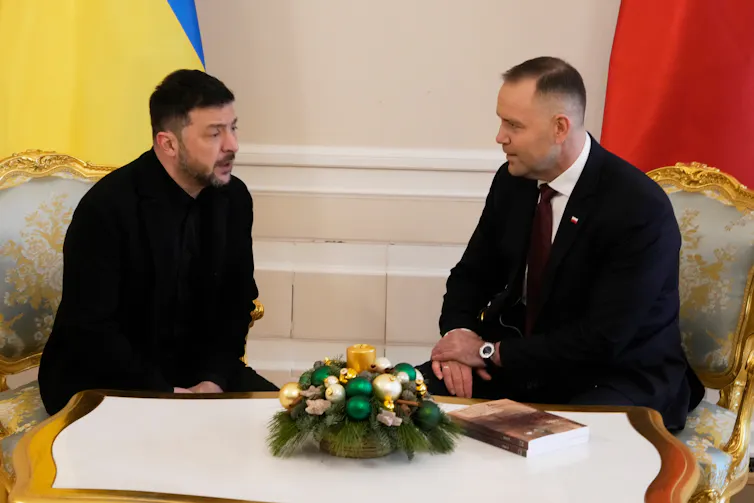 Polish President Karol Nawrocki, right, and Ukrainian President Volodymyr Zelenskyy speak during their meeting at the Presidential Palace in Warsaw in December 2025. Zelenskyy’s attendance at Andriy Melnyk’s reburial has strained the two countries’ relationship.
(AP Photo/Czarek Sokolowski)
Polish President Karol Nawrocki, right, and Ukrainian President Volodymyr Zelenskyy speak during their meeting at the Presidential Palace in Warsaw in December 2025. Zelenskyy’s attendance at Andriy Melnyk’s reburial has strained the two countries’ relationship.
(AP Photo/Czarek Sokolowski)
In protest, former Polish ambassador to Ukraine Bartosz Cichocki also returned the Order of Merit he had received from Zelenskyy in 2022.
Wartime politics and the far right
How can we explain Zelenskyy’s honouring of Ukrainian historical figures linked to wartime atrocities against Poles and Jews? This seems particularly outlandish given that Zelenskyy’s own grandfather fought the Nazis during the Second World War — a fact Zelenskyy publicly marked with a cemetery visit shortly after his 2019 election.
The answer, to a large extent, lies in Ukraine’s wartime politics. Much of eastern Ukraine has been annexed by Russian forces. Many Russian speakers from the region fled abroad — some to Russia, and many more to Europe and Canada.
Zelenskyy has little to gain from feting the Russian-speaking east. He does, however, have much to gain from courting a Ukrainian far-right that is particularly strong in the west of the country.
With the Ukrainian armed forces so desperate for manpower that draftees have been abducted on the street, the Ukrainian armed forces are becoming more reliant on ultra-nationalist elements.
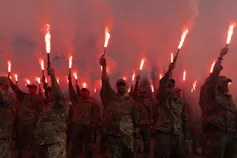 Soldiers of Ukraine’s Azov brigade light flares at a rally demanding the release of Ukrainian prisoners of war who are held in captivity in Russia, at Independence Square in Kyiv, Ukraine, in 2024.
(AP Photo/Efrem Lukatsky)
Soldiers of Ukraine’s Azov brigade light flares at a rally demanding the release of Ukrainian prisoners of war who are held in captivity in Russia, at Independence Square in Kyiv, Ukraine, in 2024.
(AP Photo/Efrem Lukatsky)
Units such as the successor to the notorious Azov Battalion are thrown into battle where the fighting is most intense. For their commitment, such units and those that support their ultra-nationalist ideals can exact a political price on Zelenskyy, who has little choice but to play along with their politics.
Read more: Not just a few bad apples: The Canadian Armed Forces has a nagging far-right problem
To what extent Zelenskyy actually believes what he is now preaching is unclear. What is however clear is that Ukraine’s far right seems to have an increasingly strong hold over Ukraine’s politics of historical memory.
- Poland
- World War II
- Nationalism
- Ukraine
- Nazi Germany
- Volodymyr Zelensky
- Russian invasion
- Ukraine-Russian war
Author
-
 Alexander Hill
Professor of Military History, University of Calgary
Disclosure statement
Alexander Hill does not work for, consult, own shares in or receive funding from any company or organisation that would benefit from this article, and has disclosed no relevant affiliations beyond their academic appointment.
Partners

University of Calgary provides funding as a founding partner of The Conversation CA.
University of Calgary provides funding as a member of The Conversation CA-FR.
View all partners
DOI
https://doi.org/10.64628/AAM.qv9k7cmyy
Events
Jobs
-

Deputy Editor, Arts and Culture
-
Forensicare Postdoctoral Research Fellow/Research Fellow
-
Police Cadet, South Australia Police

- Editorial Policies
- Community standards
- Republishing guidelines
- Analytics
- Our feeds
- Get newsletter
- Who we are
- Our charter
- Our team
- Partners and funders
- Resource for media
- Contact us
-
-
-
-
Copyright © 2010–2026, The Conversation